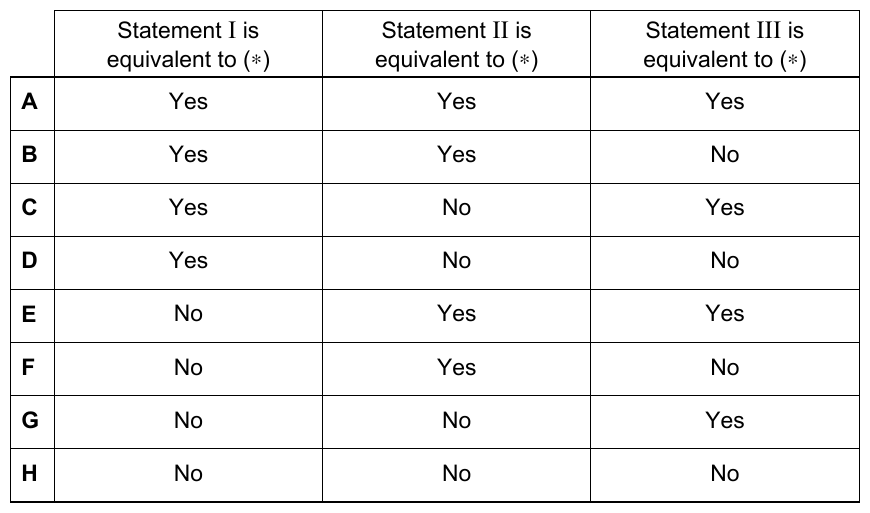
A student attempts to answer the following question: what is the largest number of consecutive odd integers that are all prime? The student's attempt is as follows. I: There are two consecutive odd integers that are prime (for example: 17, 19). II: Any three consecutive odd integers can be written in the form n−2, n, n+2 for some n. III: If n=3k+1, then n+2=3(k+1), which is a multiple of 3. IV: If n=3k+2, then n−2=3k, which is a multiple of 3. V: The only other possibility is that n is a multiple of 3. VI: In each case, one of n+2, n−2 and n is a multiple of 3, so not prime. VII: Therefore the largest number of consecutive odd integers that are all prime is two. Which of the following best describes this attempt?