NSAA 2020 Section 1 Part B (ESAT Physics) · interactive paper
Paper snapshot
20
Questions
20
Worked solutions
7
Chapters covered
University Admissions Tests UK (UAT-UK, Pearson VUE) · United Kingdom
NSAA 2020 Section 1 Part B (ESAT Physics)
2020
40 minutes
20 questions. Each part is annotated: check the hint if you are stuck, or reveal the worked solution once you have committed to an approach.
PART B Physics
A soldering iron has a copper tip of mass 2.0 g.
The tip is heated with 30 W of thermal power. In 50 s, the temperature of the tip increases by 200∘C.
How much energy is transferred from the tip to the surroundings in this time?
(specific heat capacity of copper =400 J kg−1∘C−1)
Thermal Physics1 mark
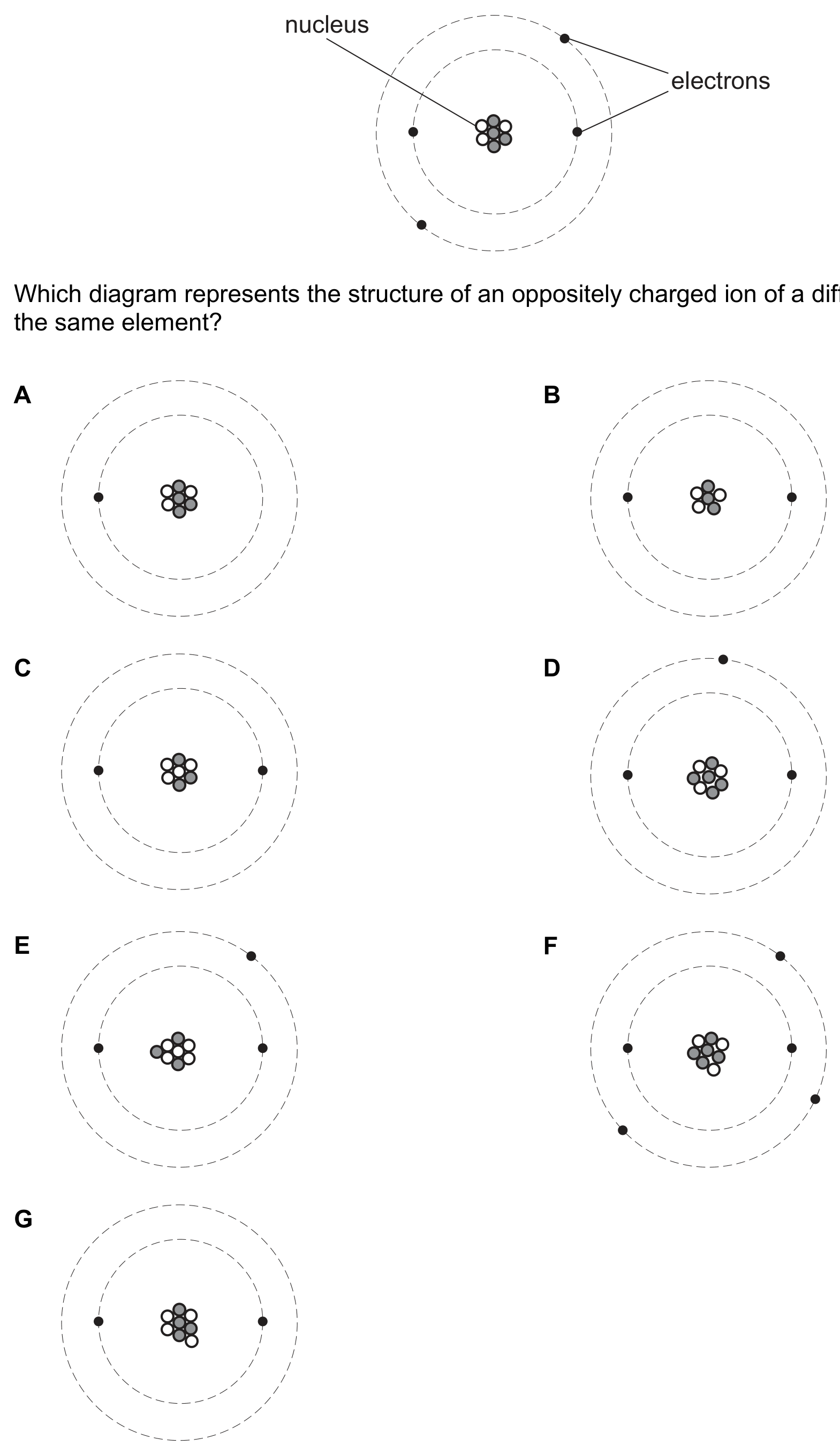
The diagram represents the structure of a charged atom (ion) of one isotope of an element: a nucleus of 4 shaded particles and 3 unshaded particles, with 2 electrons on the inner shell and 2 electrons on the outer shell.
Which diagram represents the structure of an oppositely charged ion of a different isotope of the same element?
Anucleus of 4 shaded and 3 unshaded particles (same as the original), 1 electron
Bnucleus of 3 shaded and 3 unshaded particles, 2 electrons
Radioactivity1 mark
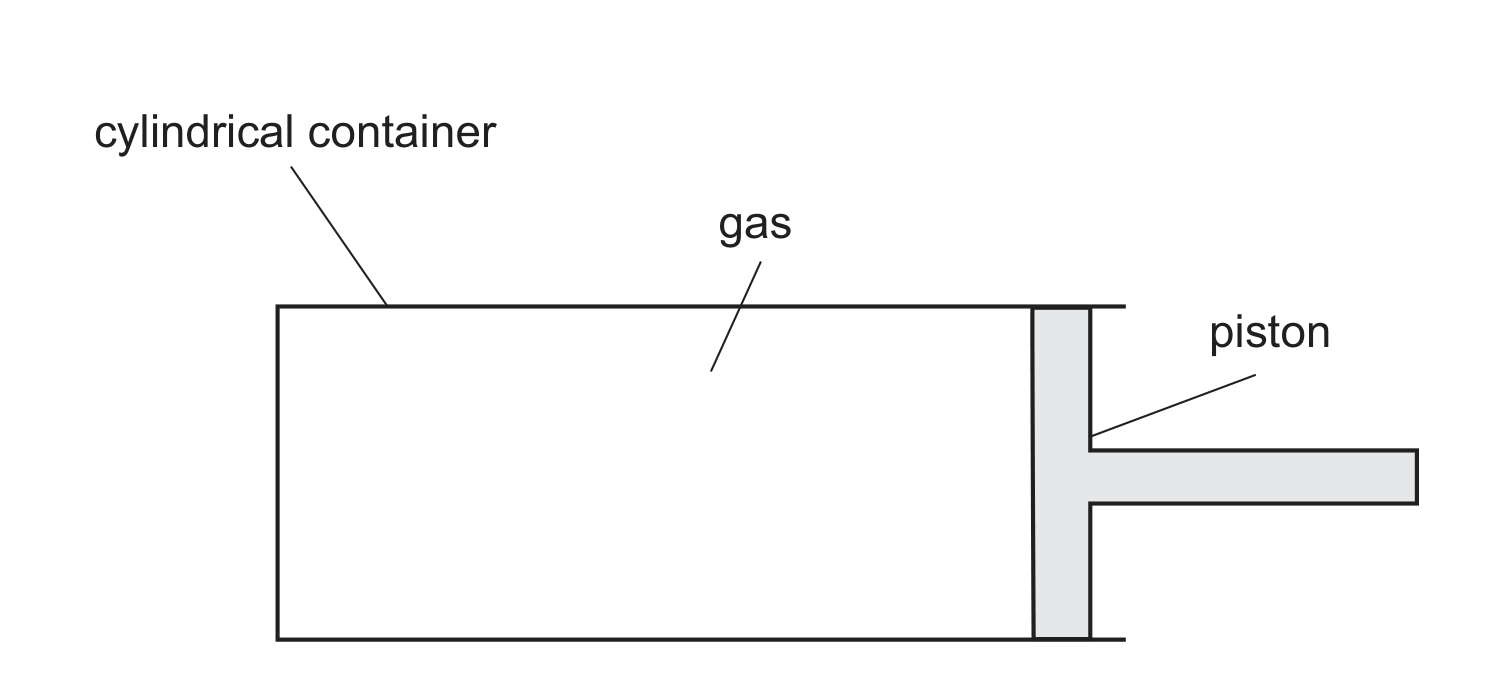
A sample of an ideal gas is sealed in a cylindrical container by a piston, as shown in the diagram.
The particles of the gas are moving with an average speed v, and collide with the surface of the piston with a frequency f.
The piston is now slowly pushed into the cylinder until the gas occupies half of its original volume, but the gas remains at the same temperature.
What is the new average speed of the particles of the gas, and at what frequency do they now collide with the surface of the piston?
illustrative
Aaverage speed 2v, frequency 21f
Matter1 mark
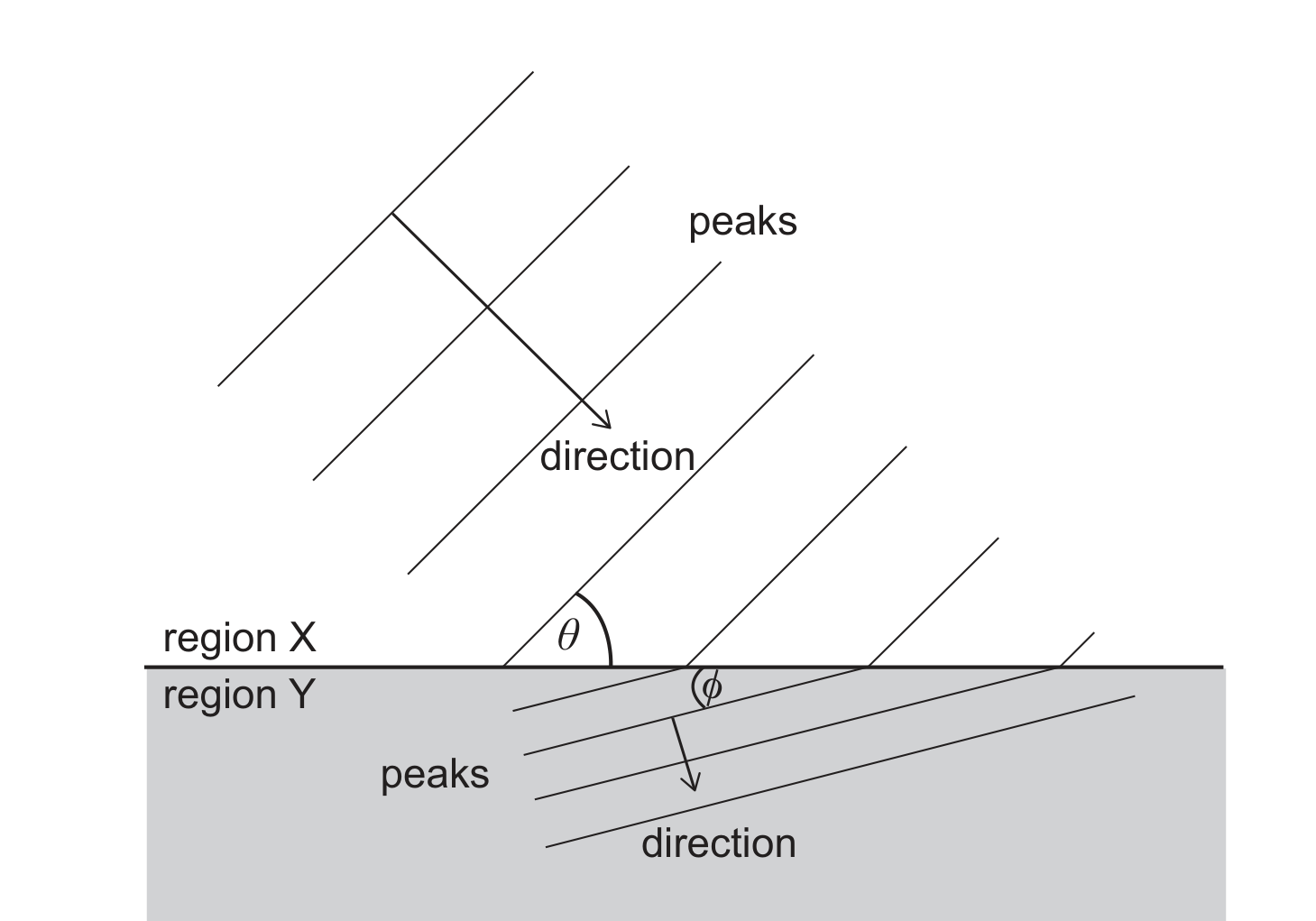
A water wave is travelling in a shallow tank of water. The wave passes from region X into region Y where the speed of the wave differs from that in region X. The diagram shows the directions of travel in the two regions and peaks of the wave that are separated by one wavelength.
In region X, the angle between the wave peaks and the boundary between the regions is θ.
In region Y, the angle between the wave peaks and the boundary is ϕ (measured in the diagram as a visibly smaller angle than θ).
What are the angle of incidence and the angle of refraction, and in which region is the speed of the wave greater?
Aangle of incidence θ, angle of refraction ϕ, speed greater in region X
Bangle of incidence θ, angle of refraction ϕ, speed greater in region Y
Waves, Sound & the Electromagnetic Spectrum1 mark
Uranium-238 (92238U) decays by a series of alpha and beta (β−) emissions to become the stable isotope lead-206 (82206Pb).
How many beta (β−) particles are emitted in the decay of one uranium-238 nucleus to lead-206?
Radioactivity1 mark
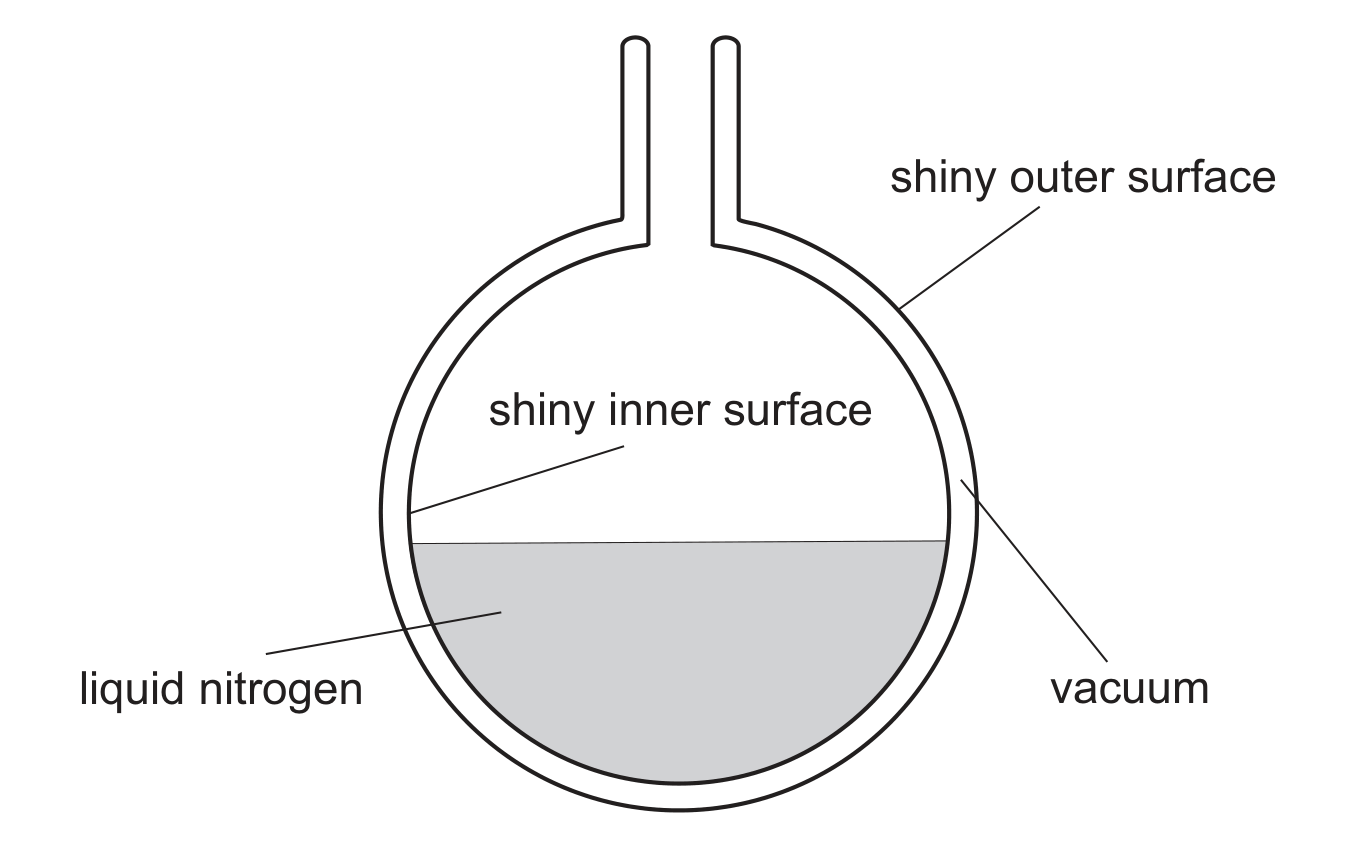
In a laboratory, liquid nitrogen is stored at a very low temperature in a double-walled vessel with a vacuum in the gap between the two walls. The vessel is made from a poor thermal conductor. The inner surface of the inner wall is shiny, and the outer surface of the outer wall is shiny.
These features insulate the liquid nitrogen by reducing the rate at which thermal energy is transferred to the liquid nitrogen.
Which of the following statements explain(s) why these features help to insulate the liquid nitrogen?
1. The shiny inner surface of the inner wall is a good emitter of thermal radiation. 2. Thermal radiation cannot travel in a vacuum. 3. The shiny outer surface of the outer wall is a poor absorber of radiation.
illustrative
Anone of them
B1 only
C2 only
D3 only
E1 and 2 only
F1 and 3 only
G2 and 3 only
H
Thermal Physics1 mark
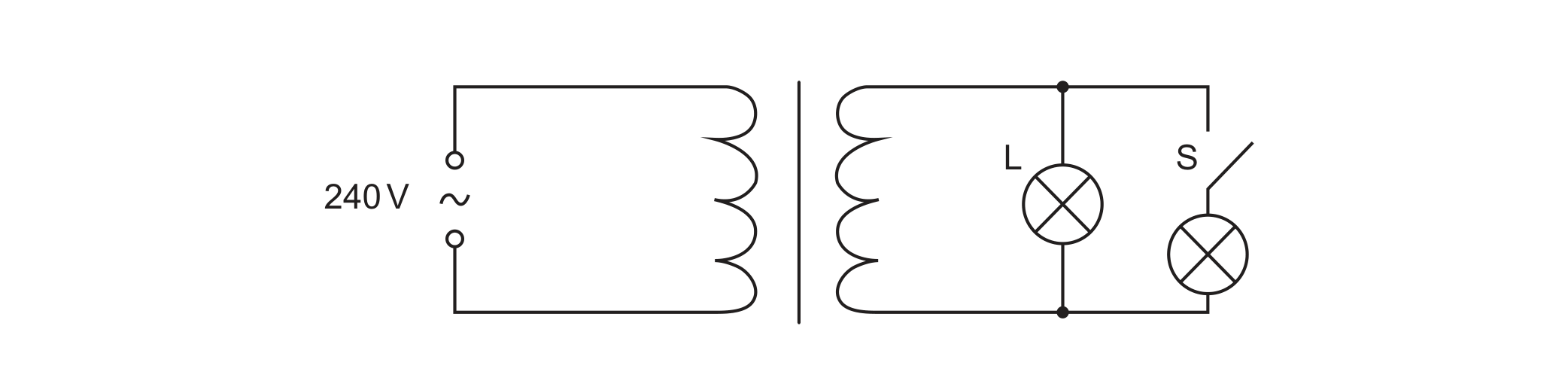
The primary coil of an ideal, 100% efficient transformer is connected to a 240 V mains supply.
A lamp L that is connected to the secondary coil has a voltage of 12 V across it. An identical lamp and a switch S are also connected to the transformer: lamp L is connected directly across the secondary coil, and a second, identical lamp in series with switch S forms a separate branch also connected across the secondary coil.
With the switch open, the current in the primary coil is 0.10 A.
The switch is now closed.
What is the current in the primary coil now and what is the current in lamp L?
Acurrent in primary coil 0.10 A, current in lamp L 1.0 A
Electricity & Magnetism1 mark
A dc electricity transmission system uses an undersea cable to send electricity from one country to another. On a particular day, the first country supplies electricity at a voltage of 400 kV and 2000 A to the transmission system. The second country receives electricity from the transmission system at 160 kV and 4000 A.
What is the percentage efficiency of the system and how much energy is wasted every minute?
Aefficiency 20%, energy wasted every minute 9.6×10⁹ J
Befficiency 20%, energy wasted every minute 3.84×10¹⁰ J
Electricity & Magnetism1 mark
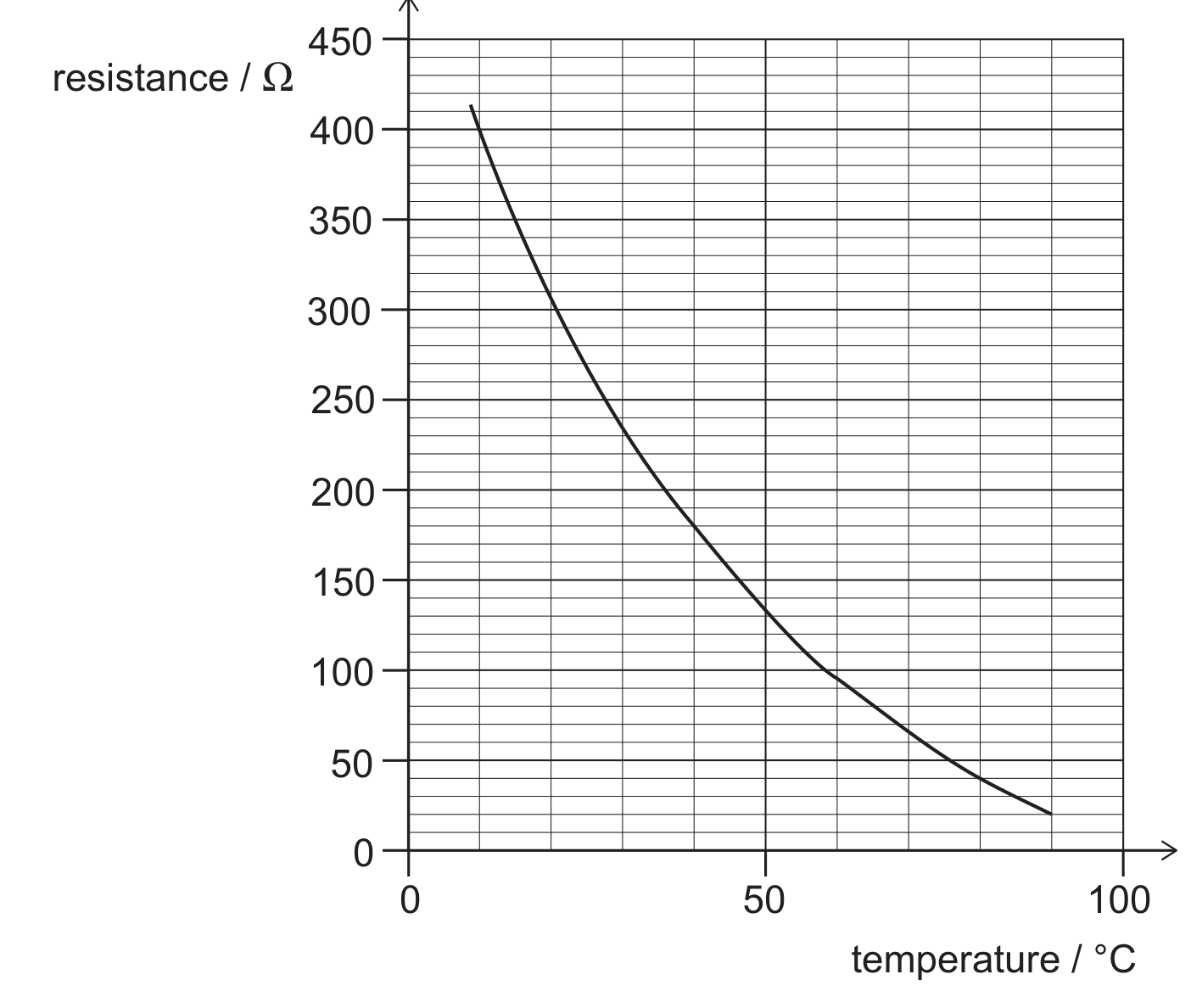
A circuit contains a 12 V battery, a thermistor and a fixed resistor connected in series. The graph shows how the resistance of the thermistor varies with temperature: it falls smoothly from about 400Ω at 10∘C to about 40Ω at 80∘C.
When the temperature of the thermistor is 10∘C the current in the circuit is 25 mA.
What is the current when the temperature of the thermistor is 80∘C?
Electricity & Magnetism1 mark
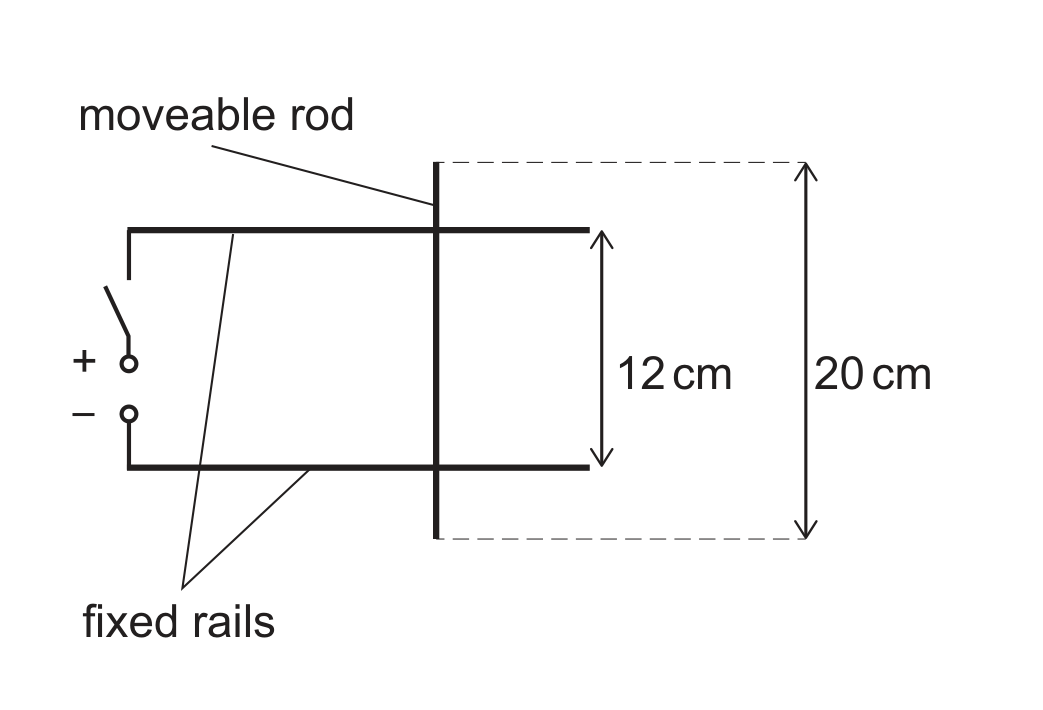
Two fixed horizontal metal rails are side by side and 12 cm apart. The rails are connected to a dc power supply by a switch that is initially open.
A freely moveable metal rod of length 20 cm is placed on the rails, perpendicular to them (angle 90∘), as shown in the diagram (seen from above).
The whole arrangement is placed in a uniform magnetic field of magnitude 0.50 T that is directed perpendicularly into the page.
The moveable rod has a weight of 0.40 N.
The switch is now closed. As a result, there is a current of 2.4 A in the circuit and the rod moves.
What is the initial magnitude of the acceleration of the rod and what is its direction?
(gravitational field strength =10 N kg−1)
Electricity & Magnetism1 mark
Visible light waves are electromagnetic waves that travel through a vacuum at 300000 km s−1 with wavelengths that range from 400 nm to 750 nm.
The electromagnetic waves emitted by a source are all at frequencies between 6.0×10¹² Hz and 6.0×10¹⁴ Hz.
Which statement about the waves emitted by the source is correct?
Waves, Sound & the Electromagnetic Spectrum1 mark
Two trolleys are moving towards each other along a straight horizontal track.
One trolley has mass 8.0 kg and is travelling to the right at 4.0 m s−1.
The other trolley has mass 2.0 kg and is travelling to the left at 1.0 m s−1.
When the trolleys collide they stick together.
How much kinetic energy is transferred to other forms of energy in the collision?
A2.0 J
B18 J
Energy, Work & Momentum1 mark
A car of mass 800 kg travels in a straight line along a horizontal road.
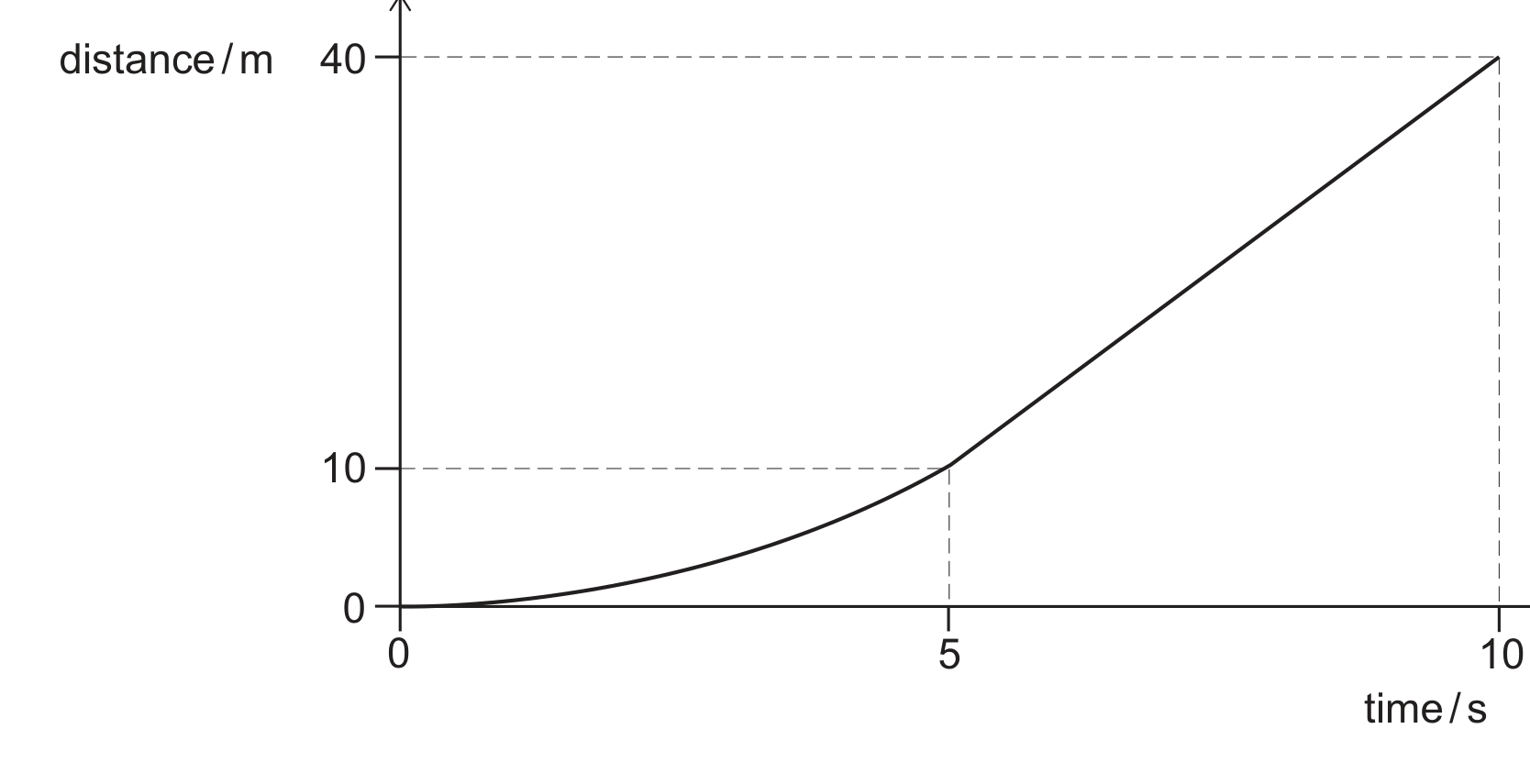
The car accelerates non-uniformly from rest for 5.0 seconds and then moves at constant speed, as shown in a distance-time graph: the car covers 10 m in the first 5.0 s (a curved, accelerating section from rest), and then a further 30 m (from 10 m to 40 m) in the next 5.0 s at constant speed.
What is the average resultant force acting on the car over the time for which it is accelerating?
Kinematics & Forces1 mark
Cubes of side 2.0 cm are tightly packed into a rectangular box with internal dimensions 12.0 cm×10.0 cm×6.0 cm.
Each cube is either solid concrete or solid steel. There are twice as many steel cubes as concrete cubes.
What is the total mass of the cubes in the box?
(density of concrete =2.0 g cm−3; density of steel =8.0 g cm−3)
Matter1 mark
P and Q are two fixed points on the surface of the ocean which are 6.0 m apart.
An ocean wave travels in the direction P to Q.
The wave has a frequency of 0.50 Hz and travels at a constant speed.
A wave peak passes Q at time t=0 s.
The next wave peak travelling towards Q passes P at time t=0.80 s.
What is the speed of the wave?
A2.1 m s−1
B3.4 m s−1
Waves, Sound & the Electromagnetic Spectrum1 mark
A sample contains only one radioactive isotope. This isotope decays in a single step with a half-life of 120 minutes to a stable isotope.
The sample is placed near to a radiation detector which measures the count rate. The count rate reading is 910 counts per minute (cpm).
After 240 minutes the measurement is repeated. The count rate reading is now 238 cpm.
After a further 360 minutes have elapsed, a third measurement of the count rate is made.
What is the count rate due to background radiation and what is the expected reading in the third measurement?
Abackground 224 cpm, third measurement 148 cpm
Bbackground 224 cpm, third measurement 226 cpm
Radioactivity1 mark
A solid uniform sphere is made of metal of density ρS and has radius r and volume V. It falls vertically through a viscous liquid of density ρL.
Three forces act on it: its weight, a drag force D and an upthrust U. The magnitude of the upthrust force is equal to the weight of the liquid displaced by the sphere.
The magnitude of the drag force is given by:D=krvwhere v is the speed of the metal sphere and k is a constant.
What is the terminal speed of the metal sphere as it falls through this liquid?
(gravitational field strength =g)
Kinematics & Forces1 mark
A parachutist of mass 80.0 kg drops from a plane travelling at 40.0 m s−1, 2000 m above the Earth's surface.
The parachutist hits the ground at a speed of 5.00 m s−1.
How much work is done by the parachutist against drag forces during the fall?
(Take the Earth's gravitational field strength to be 10.0 N kg−1.)
A1535000 J
Energy, Work & Momentum1 mark
A light spring of unstretched length 0.10 m has a spring constant of 20 N m−1. The spring is suspended so that it is vertical and a load of mass 0.050 kg is attached to the end of the spring.
The load is pulled vertically downwards until the length of the spring is 0.30 m. The load is then released.
What is the speed of the load at the instant that the spring returns to its unstretched length?
(gravitational field strength =10 N kg−1; assume that resistive forces are negligible)
A0 m s−1
Energy, Work & Momentum1 mark
A rocket travelling in space is burning its fuel at a constant rate. By expelling the burnt fuel through a nozzle, the engine is applying a constant force to the rocket.
What is happening to the magnitude of the acceleration of the rocket?
AIt is increasing at an increasing rate.
BIt is increasing at a constant rate.
CIt is increasing at a decreasing rate.
DIt is not changing.
EIt is decreasing at an increasing rate.
FIt is decreasing at a constant rate.
GIt is decreasing at a decreasing rate.
Kinematics & Forces1 mark
A160 J
B500 J
C1340 J
D1500 J
E1660 J
F1840 J
G2500 J
Cnucleus of 3 shaded and 4 unshaded particles, 2 electrons
Dnucleus of 5 shaded and 3 unshaded particles, 3 electrons
Enucleus of 3 shaded and 5 unshaded particles, 3 electrons
Fnucleus of 5 shaded and 3 unshaded particles, 5 electrons
Gnucleus of 4 shaded and 4 unshaded particles, 2 electrons
Baverage speed 2v, frequency f
Caverage speed 2v, frequency 2f
Daverage speed v, frequency 21f
Eaverage speed v, frequency f
Faverage speed v, frequency 2f
Cangle of incidence θ, angle of refraction 90∘−ϕ, speed greater in region X
Dangle of incidence θ, angle of refraction 90∘−ϕ, speed greater in region Y
Eangle of incidence 90∘−θ, angle of refraction ϕ, speed greater in region X
Fangle of incidence 90∘−θ, angle of refraction ϕ, speed greater in region Y
Gangle of incidence 90∘−θ, angle of refraction 90∘−ϕ, speed greater in region X
Hangle of incidence 90∘−θ, angle of refraction 90∘−ϕ, speed greater in region Y
A6
B8
C10
D12
E14
F16
1, 2 and 3
B
current in primary coil 0.10 A, current in lamp L 2.0 A
Ccurrent in primary coil 0.10 A, current in lamp L 4.0 A
Dcurrent in primary coil 0.20 A, current in lamp L 1.0 A
Ecurrent in primary coil 0.20 A, current in lamp L 2.0 A
Fcurrent in primary coil 0.20 A, current in lamp L 4.0 A
Cefficiency 20%, energy wasted every minute 4.8×10¹⁰ J
Defficiency 80%, energy wasted every minute 9.6×10⁹ J
Eefficiency 80%, energy wasted every minute 3.84×10¹⁰ J
Fefficiency 80%, energy wasted every minute 4.8×10¹⁰ J
A30 mA
B80 mA
C100 mA
D120 mA
E150 mA
F300 mA
G480 mA
A0.36 m s−2, to the left
B0.36 m s−2, to the right
C0.60 m s−2, to the left
D0.60 m s−2, to the right
E3.6 m s−2, to the left
F3.6 m s−2, to the right
G6.0 m s−2, to the left
H6.0 m s−2, to the right
AInfrared waves are emitted, but not ultraviolet or visible light waves.
BInfrared and visible light waves are emitted, but not ultraviolet waves.
CInfrared, ultraviolet and visible light waves are all emitted.
DUltraviolet waves are emitted, but not infrared or visible light waves.
EUltraviolet and visible light waves are emitted, but not infrared waves.