NSAA 2021 Section 1, Part D (Biology questions) · interactive paper
Paper snapshot
20
Questions
20
Worked solutions
7
Chapters covered
University Admissions Tests UK (UAT-UK, Pearson VUE) · United Kingdom
NSAA 2021 Section 1, Part D (Biology questions)
2021
40 minutes
20 questions. Each part is annotated: check the hint if you are stuck, or reveal the worked solution once you have committed to an approach.
PART D Biology
A selection pressure is a biological or physical factor in an environment that may result in evolution.
Which of the following situations result in selection pressures on one or more organisms?
1. clearing rainforests to grow palm oil plantations 2. introduction of a predator to islands with seabird colonies 3. long-term use of antibiotics in hospital wards 4. using an insecticide to kill the mosquitoes that spread malaria
A1 and 2 only
B1 and 4 only
C2 and 3 only
D1, 2 and 3 only
E2, 3 and 4 only
F1, 2, 3 and 4
Inheritance, Variation & Evolution1 mark
A particular cell has the following features:
- a cell wall - a cell membrane - no mitochondria
Which of the following statements about this cell is correct?
AIt may be an animal cell.
BIt may have no nucleus.
CIt may contain chloroplasts.
DIt contains X and Y chromosomes.
EIt is not able to respire.
Cells1 mark
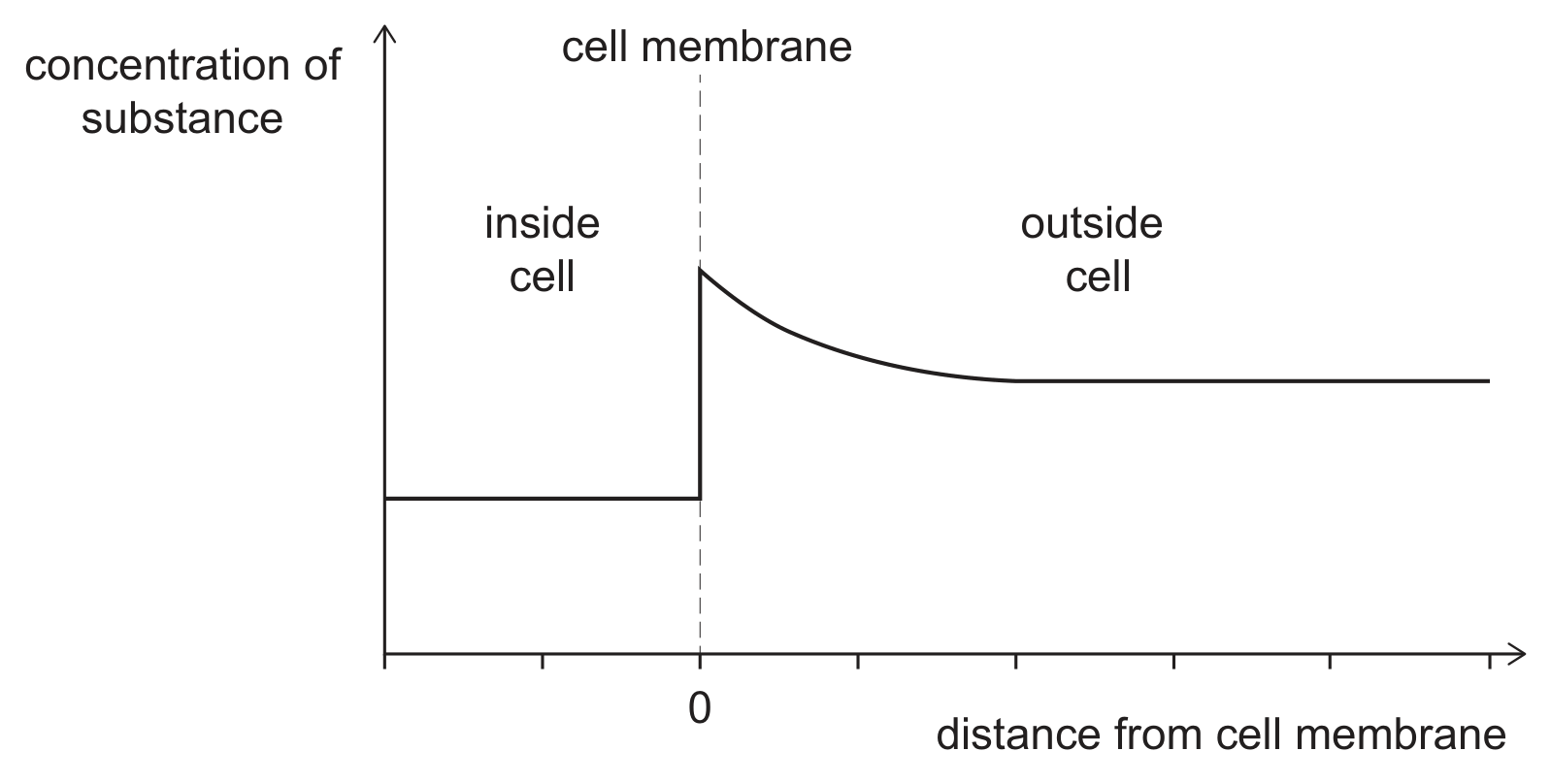
A cell is studied. The graph shows the concentration of a substance at different distances from the cell membrane.
The concentrations shown are maintained over time.
Which of the following processes is/are responsible for maintaining the difference in the concentration of the substance across the membrane?
1. active transport 2. diffusion 3. osmosis
Anone of them
B1 only
C2 only
D3 only
E1 and 2 only
F1 and 3 only
G2 and 3 only
H1, 2 and 3 only
Membrane Transport, Cell Division & Reproduction1 mark
The diagram shows some of the ways in which glucose can be added to or removed from blood plasma in humans.
Which hormones stimulate the processes shown by the arrows?
(Each option gives the hormone(s) for process 1, process 2 and process 3.)
A1 adrenaline; 2 glucagon; 3 insulin
B1 adrenaline; 2 adrenaline and glucagon; 3 glucagon
C1 insulin; 2 adrenaline; 3 glucagon
D1 insulin; 2 insulin; 3 adrenaline and glucagon
E1 glucagon; 2 insulin; 3 glucagon
F1 glucagon; 2 glucagon; 3 insulin
Animal Physiology: Systems, Homeostasis & Disease1 mark
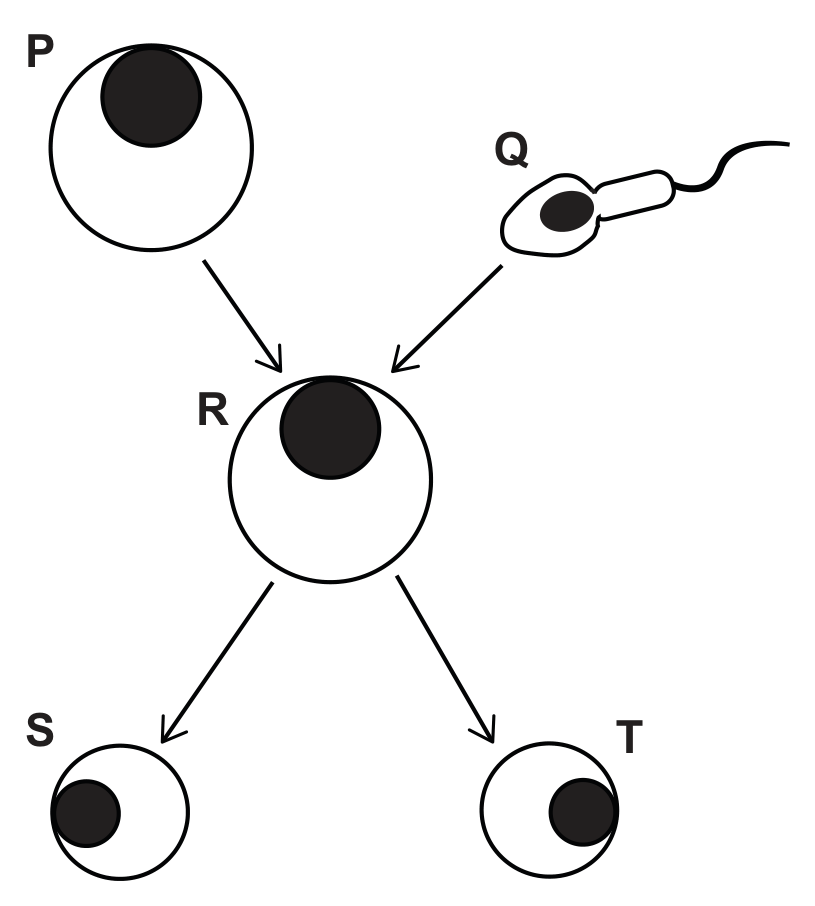
The diagram shows two gametes, gamete P and gamete Q, fusing to form cell R in a healthy human. R divides to form two cells, S and T.
S and T grow into two separate individuals.
Which of the following statements is/are correct?
1. The number of double strands of DNA is the same in gamete P and cell T. 2. If gamete Q contains a Y chromosome, then both individuals that grow from cells S and T will be genetically male. 3. A mutation in the DNA in cell R before mitosis will always change the phenotype of cell S.
illustrative
Anone of them
B1 only
C2 only
D3 only
E1 and 2 only
F1 and 3 only
G2 and 3 only
H1, 2 and 3
Membrane Transport, Cell Division & Reproduction1 mark
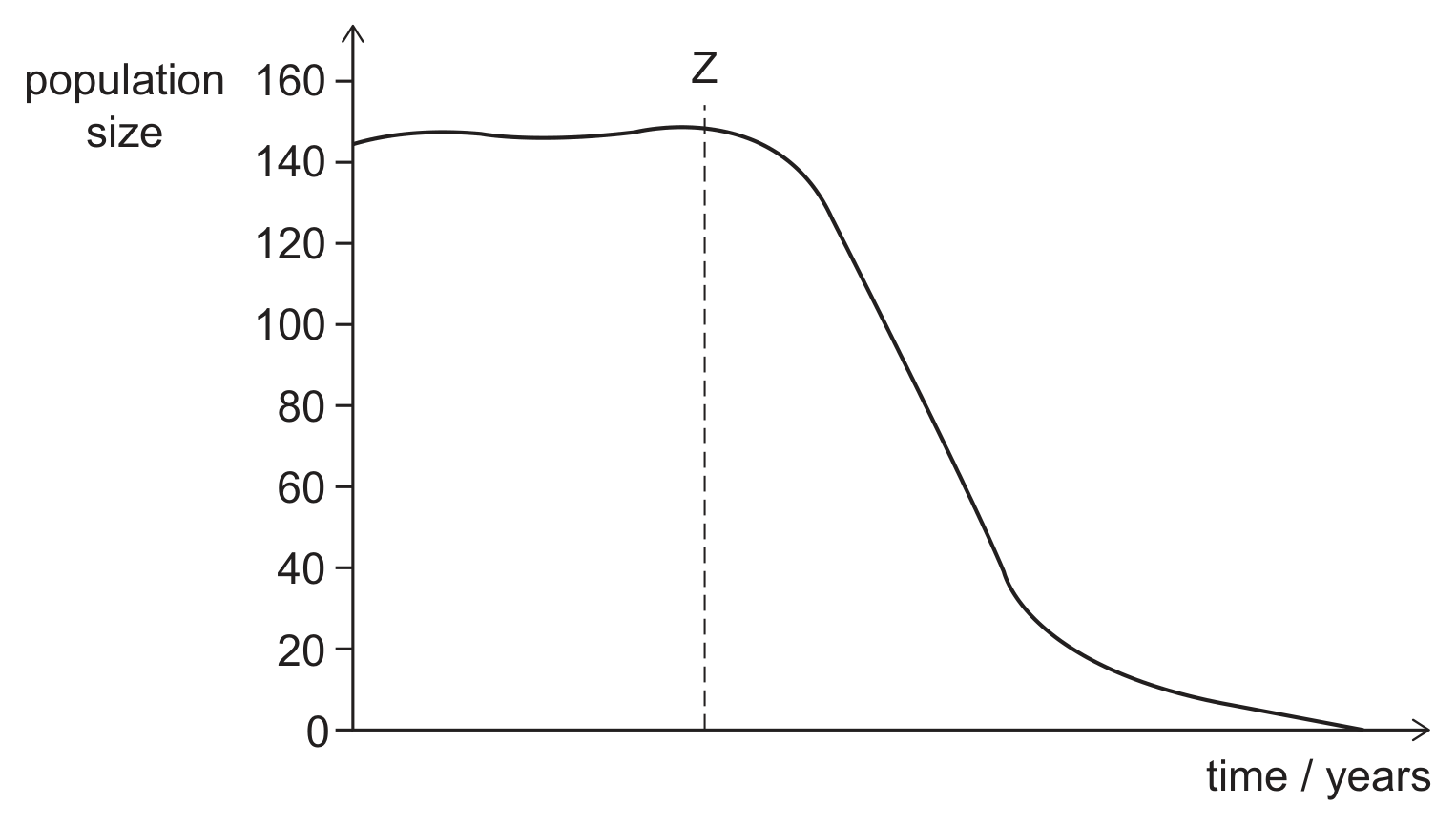
The graph shows changes in population size (number of individuals) of a species of tortoise over the last century. These tortoises are only found on one small island in the Galapagos.
Which of the following could account for the change in population shown after time Z on the graph?
1. reduced rainfall 2. reduced availability of resources 3. failure to adapt to competition from an introduced species
Anone of them
B1 only
C2 only
D3 only
E1 and 2 only
F1 and 3 only
G2 and 3 only
H1, 2 and 3
Ecology & Plant Physiology1 mark
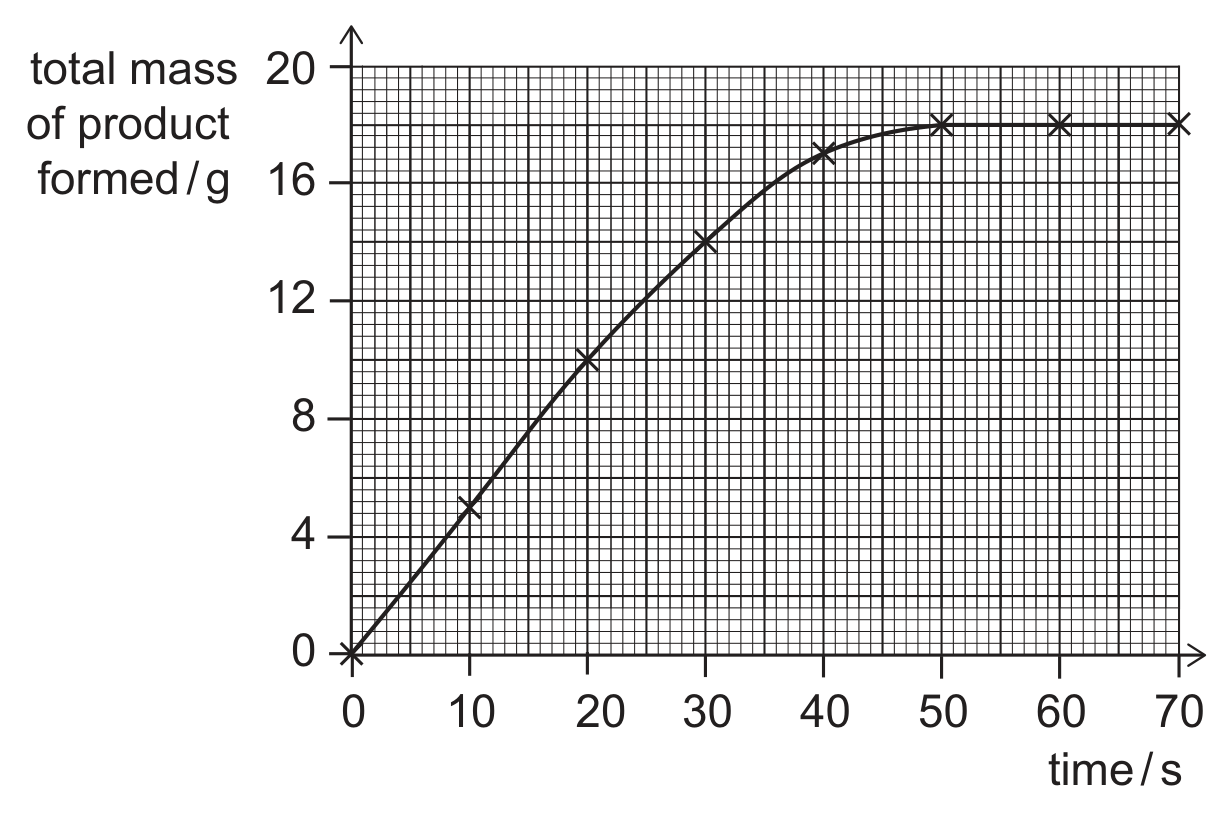
An enzyme-catalysed reaction was studied and the mass of product formed was measured over time.
The results are shown in the graph.
Which of the following statements is/are correct?
1. The enzymes may have been used up in the reaction. 2. The initial rate of reaction is 120 g min−1. 3. At high concentrations, the product formed may inhibit the enzymes.
Anone of them
B1 only
C2 only
D3 only
E1 and 2 only
F1 and 3 only
G2 and 3 only
Enzymes1 mark
A person ran on a treadmill for 360 seconds. Their rates of aerobic and anaerobic respiration were measured at the start and at the end of the time. The table shows the results.rate of aerobic respiration / arbitrary unitsrate of anaerobic respiration / arbitrary unitstime=0 seconds1.010.01time=360 seconds5.773.67Physiological changes occured in the person during this time.
Which of the following statements is/are correct during the 360 seconds?
1. There was an increase in pH that caused a change in the shape of the respiratory enzyme's active sites. 2. Part of the increase in the rate of cellular respiration may have been due to a temperature increase in the muscles. 3. More carbon dioxide needed to be removed from the muscle cells.
Animal Physiology: Systems, Homeostasis & Disease1 mark
Coat colour variation in a particular population of mice is only affected by one gene with two alleles, R and r. This gene is not on a sex chromosome.
Heterozygous mice have yellow fur. Embryos that are homozygous dominant do not survive.
A yellow male and a yellow female mouse were mated several times and a large number of offspring were produced. Some of the offspring were grey in colour and others were yellow.
Assuming that no new mutations have occurred, which of the following is correct?
A25% of the live offspring will be grey in colour.
BAll grey mice have a homozygous genotype for coat colour.
COffspring with XY chromosomes are all heterozygous for coat colour.
DThe live offspring of a cross between a yellow and a grey mouse will always be yellow.
EThere is a 3:1 ratio of dominant to recessive alleles for this gene in the live offspring.
Inheritance, Variation & Evolution1 mark
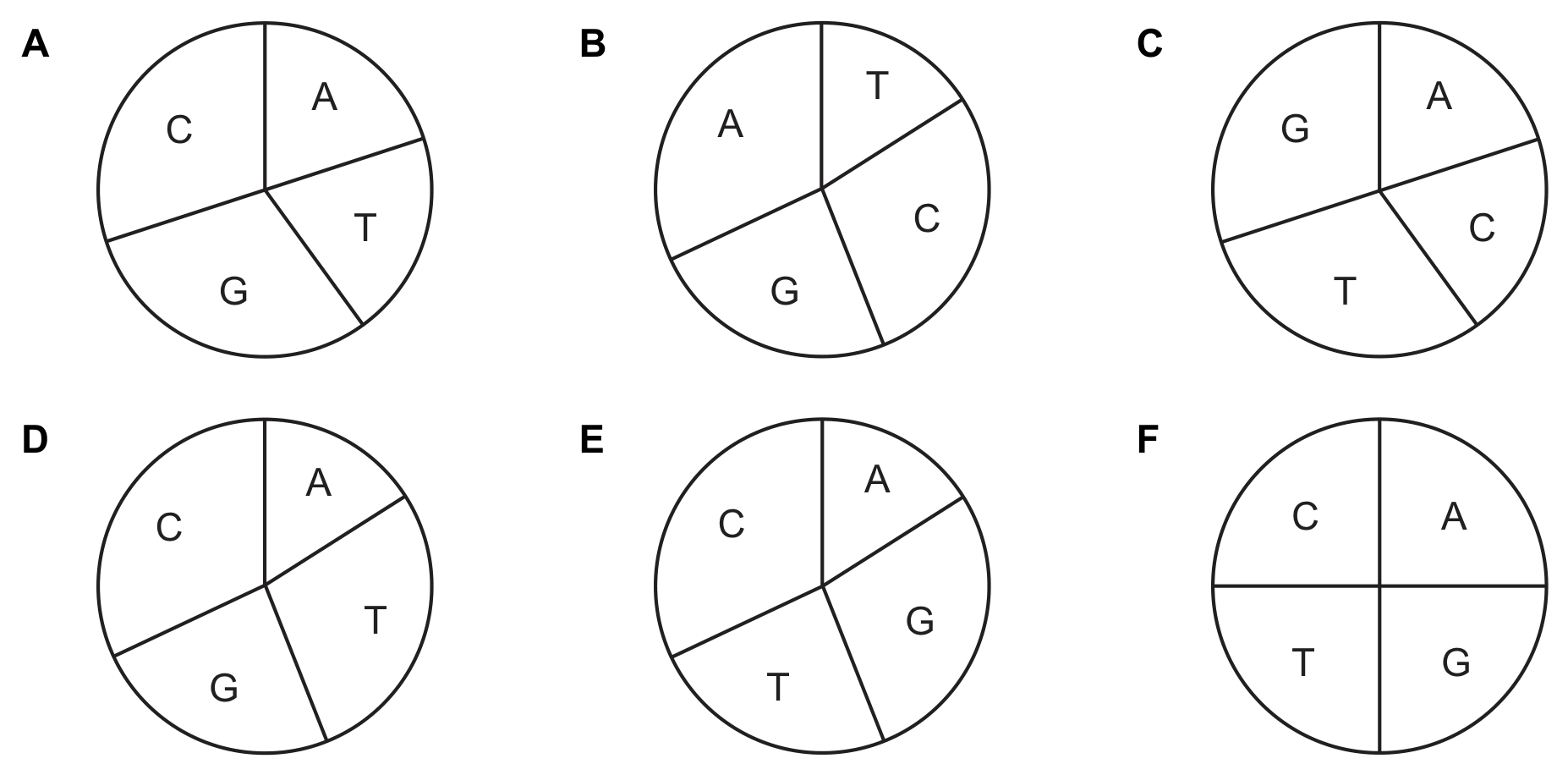
One strand of a section of DNA has the following sequence of bases:
AATCGGTCTTGCGGCCAAGGCCCTT
The complementary strand is not shown.
The charts show the proportions of the four bases A, C, G and T.
Which chart shows the correct proportions of bases for this section of double-stranded DNA?
(Assume no mutations.)
(The six pie charts A to F are shown in the figure; each option below describes its chart in words.)
AA and T about 20% each, C and G about 30% each
BT about 16%, G about 24%, C about 28%, A about 32%
CA and C about 20% each, T and G about 30% each
DA about 16%, G about 24%, T about 28%, C about 32%
EA about 16%, T about 24%, G about 28%, C about 32%
FA, C, G and T 25% each
DNA, Protein Synthesis & Gene Technology1 mark
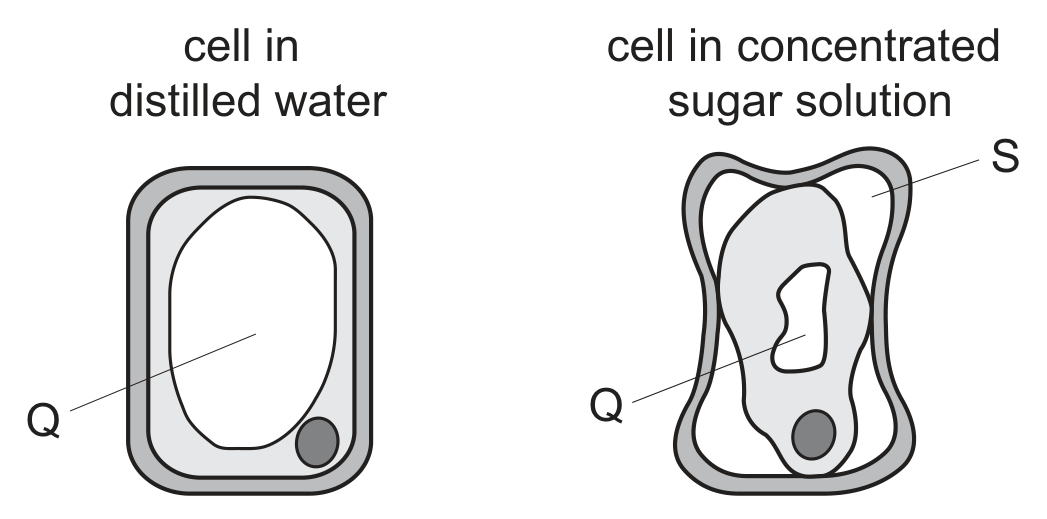
Two identical plant cells were removed from a leaf. One was placed in a concentrated sugar solution and the other was placed in distilled water, and both were left for 2 hours.
All other factors were kept constant during the experiment. The diagram shows the results, with regions of each cell labelled Q and S.
Which of the following statements is/are correct?
1. In the cell in distilled water, Q contains only distilled water. 2. In the cell in concentrated sugar solution, the number of solute particles in Q increased over the two hours. 3. S is a vacuum.
Anone of them
B1 only
C2 only
D3 only
E1 and 2 only
F1 and 3 only
G2 and 3 only
H1, 2 and 3
Membrane Transport, Cell Division & Reproduction1 mark
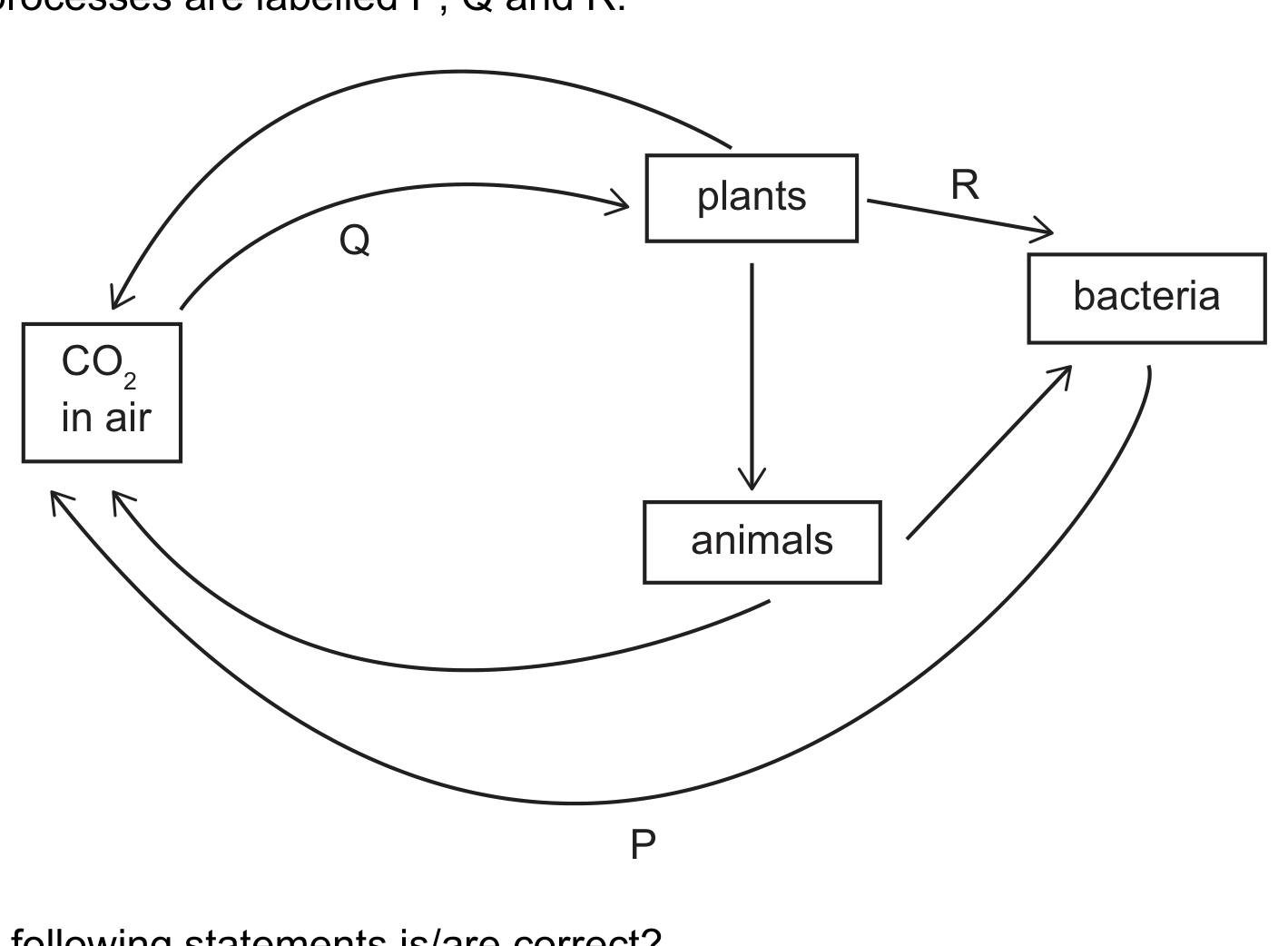
The diagram shows some chemical processes involved in the carbon cycle. Three of these multi-stage processes are labelled P, Q and R.
Which of the following statements is/are correct?
1. P requires the presence of mitochondria. 2. Overall, Q releases heat. 3. R is sensitive to changes in pH and temperature.
Anone of them
B1 only
C2 only
D3 only
E1 and 2 only
F1 and 3 only
G2 and 3 only
H1, 2 and 3
Ecology & Plant Physiology1 mark
Two different cells, cell L and cell M, were studied using a microscope and then drawn. The drawings are not shown.
Some of the data collected is shown in the table.actual maximum length of cell / μmmaximum length of cell in drawing / cmcell L4002cell M401Which of the following statements is/are correct?
1. Cell L has been magnified 50 times. 2. Cell M has been magnified 5 times as much as cell L. 3. Both cells could have a cell wall.
Cells1 mark
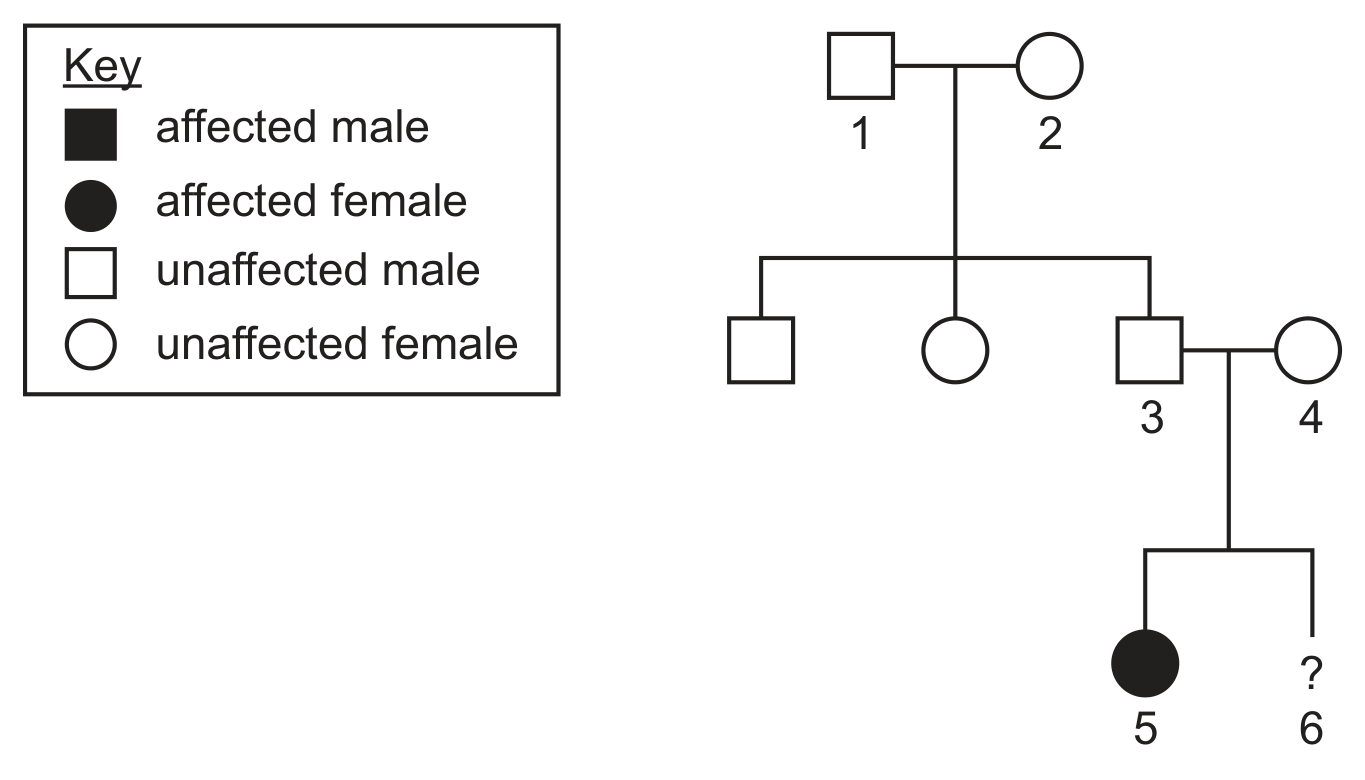
The pedigree diagram shows the inheritance of a phenotypic feature caused by a recessive allele.
What is the probability that individual 6 is an unaffected male?
A12.5%
B25%
C37.5%
D50%
E62.5%
F75%
Inheritance, Variation & Evolution1 mark
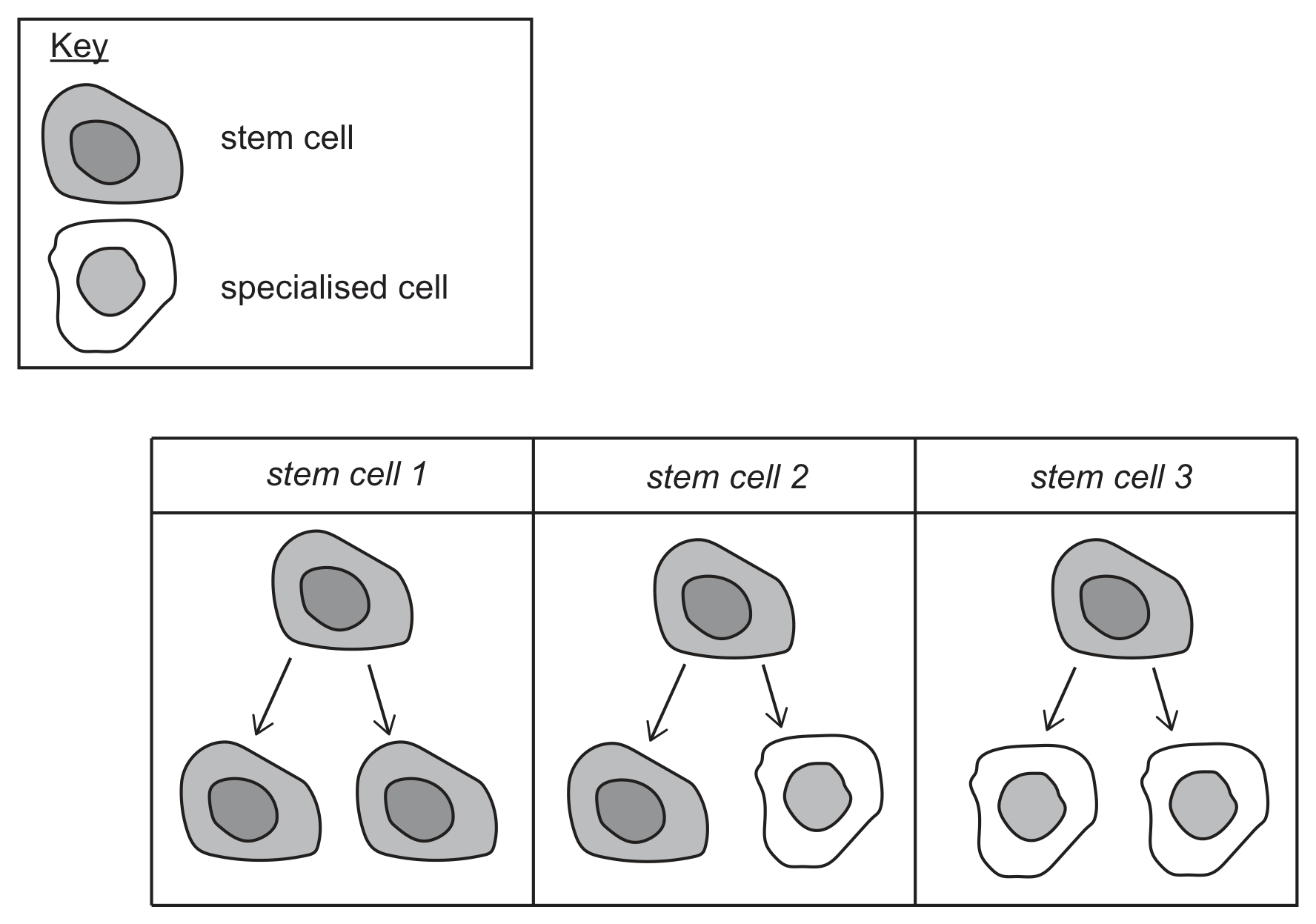
The diagrams show the daughter cells produced when three different stem cells divide.
Which of the following statements is correct?
AOnly stem cell 1 shows division by mitosis.
BSome cancers result from divisions like that shown for stem cell 1.
CThe total number of stem cells increases if they divide like stem cell 2.
DStem cells in adults divide like stem cell 3.
EThe total number of stem cells is maintained if they divide like stem cell 3.
Membrane Transport, Cell Division & Reproduction1 mark
A fungus feeds by releasing amylase onto starchy food. The soluble products of the breakdown of starch are absorbed by the fungus.
Test tubes were set up containing a mixture of starch solution and fungus. Each test tube was maintained at a different temperature between 5∘C and 45∘C.
Samples of the mixture were removed early in the experiments to determine the initial rates of this enzyme-catalysed reaction.
The results were plotted.
All of the other variables were kept constant.
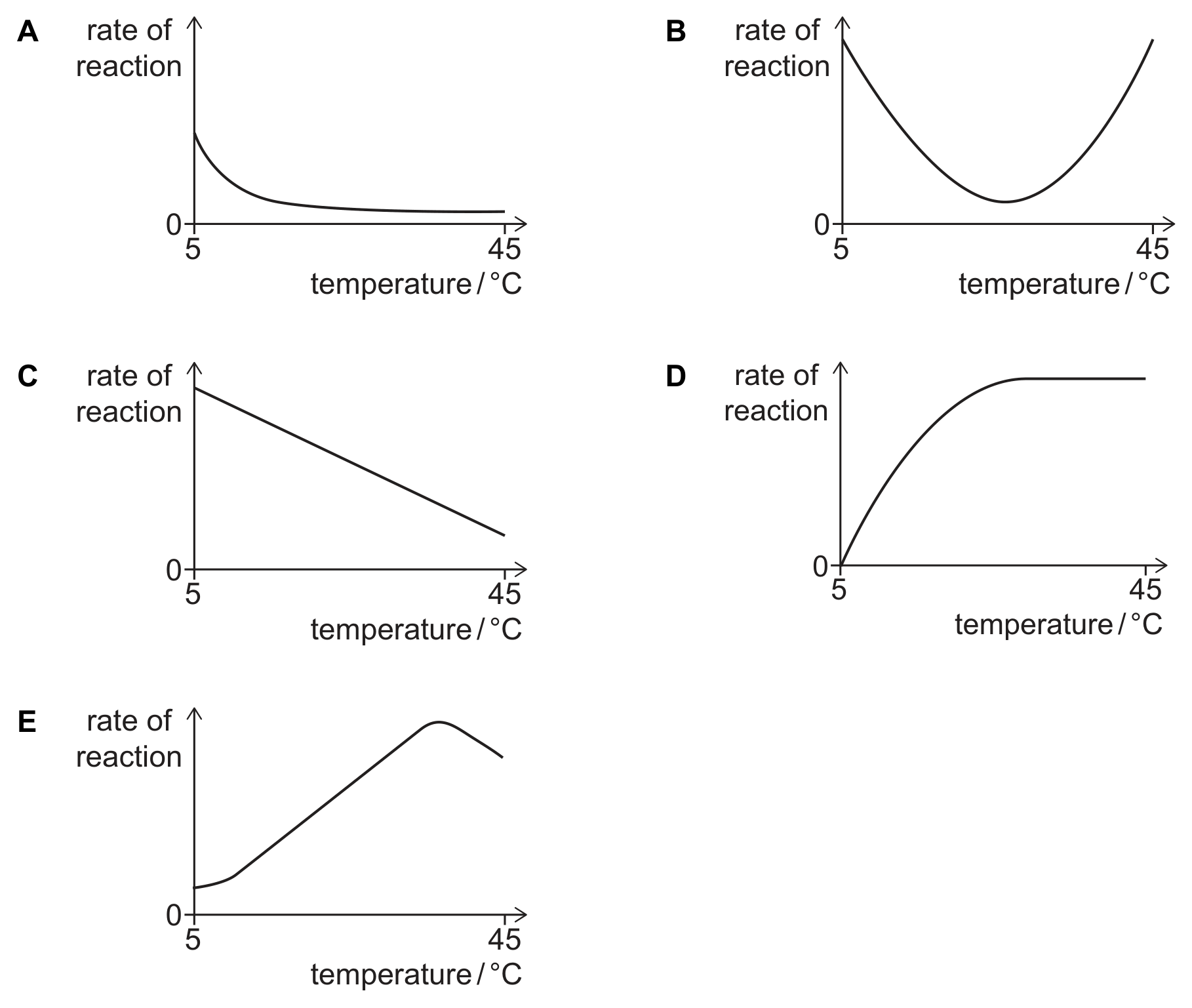
Which graph shows the expected results?
(The five graphs A to E, of rate of reaction against temperature from 5∘C to 45∘C, are shown in the figure; each option below describes its graph.)
Enzymes1 mark
Red blood cells are produced by stem cells in the bone marrow.
A 1 mm3 sample of blood from a healthy person was found to contain 4×10⁶ red blood cells.
The person has a consistent average total blood volume of 0.006 m3. Their total red blood cell count does not change and, on average, red blood cells have a lifespan of 100 days.
Which of the following statements is/are correct?
1. Red blood cells are phagocytic cells. 2. The average rate of production of red blood cells is 1×10¹⁰ cells per hour. 3. The stem cells that produce red blood cells do not have nuclei.
Animal Physiology: Systems, Homeostasis & Disease1 mark
The diagram shows the life cycle of one species of ant, in which males are haploid and females are diploid.
Which of the letters on the diagram represent(s) meiosis?
AP only
BQ only
CR only
DS only
EP and Q only
FP and R only
GP and S only
HQ and R only
Membrane Transport, Cell Division & Reproduction1 mark
A student compared the properties of different cells from one healthy human.
Which of the following statements is/are correct?
(Assume that no mutations occur.)
1. A cheek cell contains the same alleles as an embryonic stem cell. 2. A sperm cell contains the same genome as a cheek cell. 3. A white blood cell contains the same number of DNA bases as a mature red blood cell. 4. An embryonic stem cell produces all of the same proteins as a white blood cell.
A1 only
B2 only
C3 only
D4 only
E1 and 2 only
F1 and 3 only
G2 and 4 only
H3 and 4 only
Cells1 mark
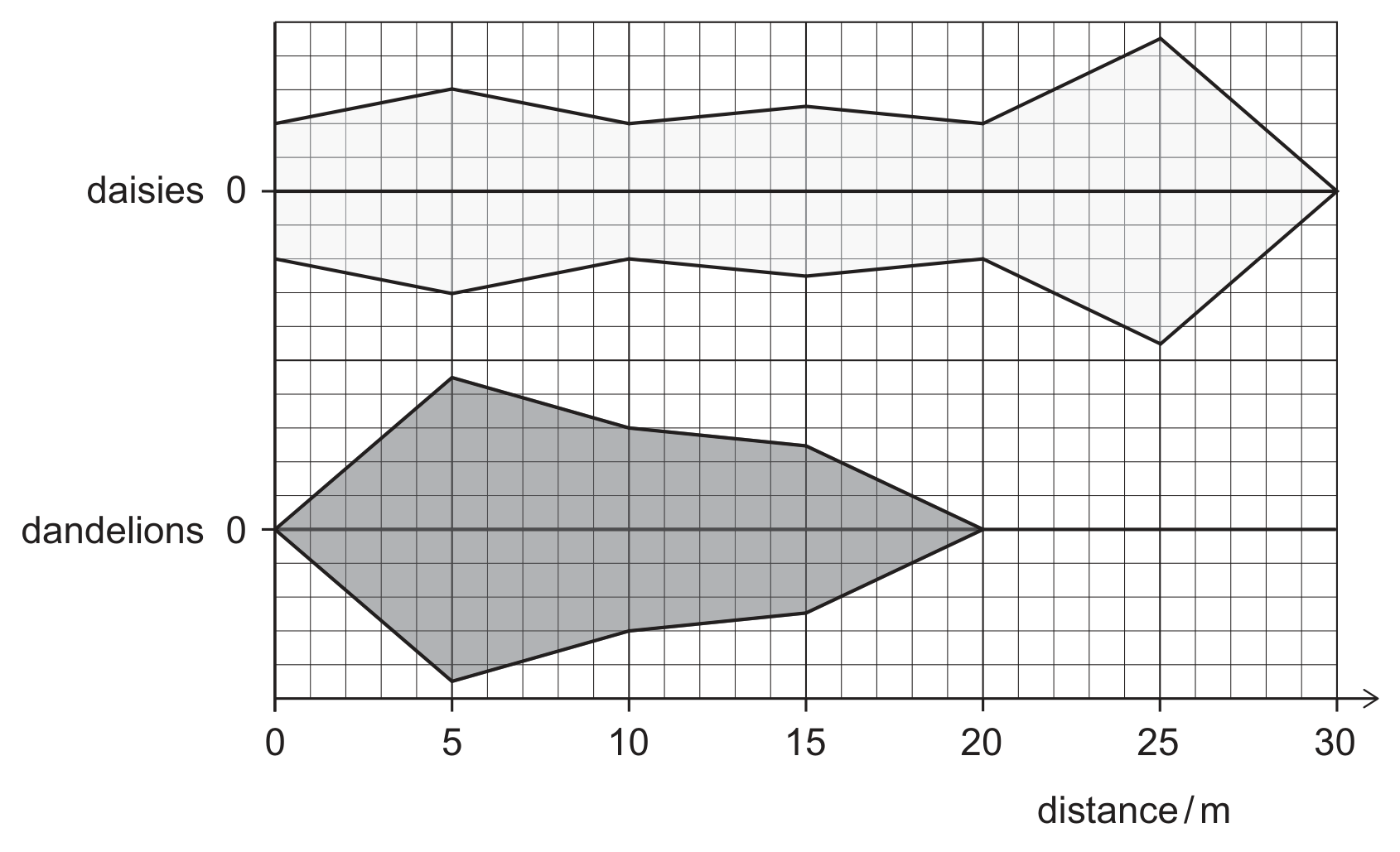
The kite diagram shows the distribution of dandelions and daisies along a transect in a field.
A quadrat with sides of 0.5 m was used to collect the data.
Each square on the vertical axis represents 1 plant. For example, in the quadrat centred at 5 m there were 6 daisies.
Which of the following statements about the data is/are correct?
1. Across the transect, the number of dandelions is proportional to the number of daisies. 2. Repeating the experiment along a different transect would result in an identical pattern. 3. The density of dandelions at 5 m is 36 plants per square metre.
Anone of them
B1 only
C2 only
D3 only
E1 and 2 only
F1 and 3 only
G2 and 3 only
H1, 2 and 3
Ecology & Plant Physiology1 mark
H
1, 2 and 3
Anone of them
B1 only
C2 only
D3 only
E1 and 2 only
F1 and 3 only
G2 and 3 only
H1, 2 and 3
Anone of them
B1 only
C2 only
D3 only
E1 and 2 only
F1 and 3 only
G2 and 3 only
H1, 2 and 3
Athe rate falls steeply from 5 degrees C and levels off close to zero
Bthe rate falls to a minimum in the middle of the range and rises again
Cthe rate falls steadily in a straight line from 5 degrees C to 45 degrees C
Dthe rate rises from zero at 5 degrees C and levels off at a constant maximum
Ethe rate rises from a low value at 5 degrees C to a peak near 40 degrees C and then falls